Friday, November 18, 2011

1937 to 2000

This past winter, I spent an afternoon in the Robinson Map Library on the UW-Madison campus.  The library has a massive collection of aerial photographs (among other things) that are categorized by location and available for scanning and downloading.  While there, it was my objective to locate as many aerials of Blackhawk over the years, and I ended up finding eleven images that span from 1937 to 2000.  Over the next few months, I'll post these images, and I hope that you'll find them to be as interesting as I have.

The image above is from 1937, and it's safe to say that there are a few less trees then than there are now.  Many of the large oaks are still near 2/11 tees, 14/15, and 18 tee.  We suspect that the large trees that are behind 8 green were elm trees.  As you will see, these trees disappear between 1968 and 1976, during the height of the dutch elm disease plight.  It's also interesting to note the road the runs through the middle of the course and the amount of bunkers that surround 5 green.  Below, I've added the 2000 picture as a comparison.

Thursday, November 10, 2011

Winter Preparations

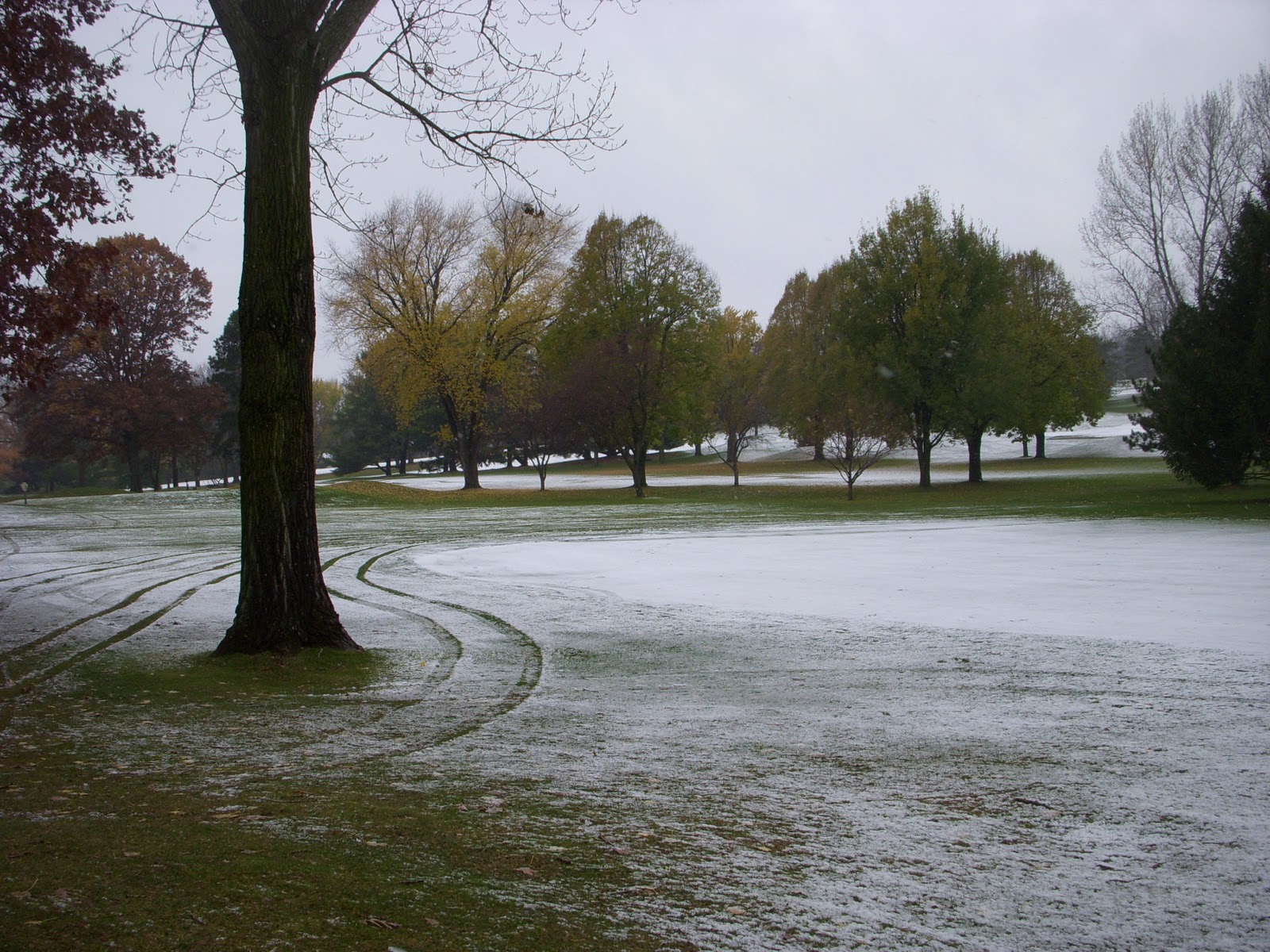
If there was any doubt that winter's just around the corner, the weather that we've been experiencing yesterday and today has certainly eliminated it.  Looking at the picture below, it's hard to imagine that we could've golfed in shorts on Monday.  It's also apparent that many of the still-green linden trees are unaware that they should be losing their leaves.


Yesterday, we soaked up (literally) the driving rain/snow and 30 mph winds by winterizing our irrigation system.  As you may remember from previous posts, a large air compressor is hooked into the system, and the water is forced from the irrigation pipes when we turn the sprinklers on.  Each sprinkler is run four times throughout the course of the day to ensure that they system is as water-free as possible.  Although it wasn't exactly a terrific day to spend outside, it's nice to have the job completed.

This morning, we also took advantage of a calm Lake Mendota to take out the plastic pipes that feed our irrigation system.  Next week, we hope to remove the cast-iron pipes that extend from the pumphouse to the plastic pipes, but this job requires a barge mounted with a crane (the same type of boat that moves around boat lifts and docks) because the metal pipes are extremely heavy and dangerous to manuever.  

The plastic pipes are out of the lake and ready for winter storage.
Still remaining on our pre-winter checklist are: remove the remaining course equipment, make the snow mold fungicide applications, sand topdress the greens, put new covers on two of the greens, and install rope and/or snow fence around certain greens and tees.  Right now, we're hoping to spray the snow mold applications on Monday and Tuesday of next week, as these days look relatively dry and calm.  Between the heavy rains, late-falling leaves, and seemingly-constant winds, we haven't had any ideal spray days, and knowing that Wisconsin's weather can change in an instant makes us just a little nervous that we haven't been able to spray yet.  But, we'll get it done one way or another.  

Friday, November 4, 2011

A Slow Fall

Our camera battery has yet to show up, but if you would, picture a green blanketed in oak leaves.  It's been a strange year for leaf fall, and there are still a lot of leaves hanging onto the oaks, maples, and lindens on the course.  After an early wave of leaf fall from the honey locusts, ashes, and some oaks, there was a considerable lull that made it relatively easy to keep the course very playable.  However, times are a-changing, and despite our best efforts, the leaf rule for lost balls will be in full effect for the remainder of the year.  From our perspective, we'd prefer to have the vast majority of the leaves on the ground and mulched going into winter, but that's not looking very likely this year.

With the cold and occasionally frosty mornings that we've been experiencing, our "winter" equipment maintenance has begun.  Our mechanic, Dave, and his team are working on cleaning and repairing the utility carts that get everyone around the course during the summer.  These carts are completed first and then stored in the cart barn by the pro shop for the winter; this opens up space and makes it much easier to move equipment around in the shop.  If you've been on the course recently, you've probably noticed that all of the benches and some of the garbage cans and ballwashers have been taken in.  This year, the benches are receiving a fresh coat of stain, and they are nearly finished already.  On a yearly basis, the ballwashers are completely disassembled for a number of reasons: 1) to assess any parts that need to be replaced, 2) for easier storage, and 3) so that the metal components can be more easily handled when they are washed, polished, and touched-up with paint.

Next week, we will be winterizing the irrigation system by forcing water out with compressed air.  The 0.9" of rain that we received this week was very well-timed and will allow us to blowout the irrigation system with confidence that the soil has enough moisture to sustain the turf plants.  Soon, we will be applying our snow mold fungicides, topdressing the greens with a heavy layer of sand, and covering two greens with some new, added protection that will be detailed in a later post.

Until then, it looks like another nice (albeit breezy) weekend to get out on the course, and if you do make it out, bring a healthy supply of golf balls to combat those pesky leaves.  

Friday, October 21, 2011

Project Days

From our perspective, one of the many nice things about fall is that the change in weather allows us to complete a number of projects around the course.  Last fall, you may remember that we installed drainage in 3 approach, and even though it was a relatively dry year, it seemed to make a dramatic difference during the heavier rains that we did receive.  This year, the main project was the releveling of the north side of 16 back tee.

Over the past year-and-a-half, we noticed that this half of the tee was beginning to drop off towards the lake, and it was making for some occassionally uneven stances.  This week, the sod on that half of the tee and tee bank were removed.  The sod from the bank was discarded, and the tee sod was carefully rolled up and moved in an orderly fashion.  Next, thin plywood boards were anchored into the ground to show the contour of the teeing surface.  After that, a significant amount of soil was added and compacted to the tee bank to raise it to the height of the surrounding steel girders, and once that was mostly done, sand was added to the teeing surface to make it level.  Finally, the tee sod was carefully laid back into place, the plywood was removed, more soil was added to the bank, and new sod was laid on the bank.  Because the renovated half of the tee is very soft, the entire tee will be closed for the remainder of the year.

If you make it out to the course to enjoy the pleasant weather this weekend, you may also notice that several other projects have been completed, including:
  • A drainage basin was added to the right side of 3 men's tee.  During wetter weather, a puddle would form in this area, and because it's a high-traffic area, it was an unsightly inconvenience.  With the new drain and sod, it should no longer be an issue.
  • A drainage basin was also added to the back of 3 green.  Despite having part-circle irrigation heads that we turn off as much as possible on the back of this green, the small bank area between the green and the out-of-bounds line never seemed to dry out and was starting to really deteriorate.  Thus, the existing sod/mud was removed and replaced with shade-tolerant tall fescue sod, and a small catch basin was installed in the lowest point.
  • New sod was added to a portion of the bank that's left of 9 green.  Due to mowing and being steep and dry, this area was also becoming more and more unsightly.  Although it didn't truly affect play because of it's steepness, it just wasn't very nice to look at.
  • There must be some sort of seismic activity between the cart path and 10 tee because the soil in this area just doesn't want to stay smooth.  After repairing the area 3 years ago, small dips were once again forming.  So, sod was stripped off, the soil was once again leveled, and new sod was laid down.
  • Sod was also added to the back right of 11 green, where sharply turning carts and mowers had created a small patch of soil.
  • Some of the tall fescue sod was patched into a small barren area just off of the south side of 15 fairway.
  • A drainage basin will be added by the flagstone that's along the cart path by 6 men's tee.  During the summer, irrigation water from 9 tee, the range tee, and 6 tee all run down the cart path and pool in this particular area.  Without fail, carts drive thru the puddle, and it gets a little messy.  Again, the drain should alleviate this problem.
  • Lastly, if we have enough sod, we will renovate a small, shoddy-looking spot that's to the north of 14 bunker.
Between the aforementioned projects, leaf cleanup, and beginning some equipment maintenance, it's been a busy week at the shop.  Unfortunately, our digital camera decided to stop working, so I was unable to take any pictures of the projects.

Have a great weekend, and we hope that you're able to enjoy the next few nice, less windy days on the course.

Wednesday, October 12, 2011

Fall Work

Although the temperatures have been unseasonably warm recently, fall is in full effect on the course.  Maybe it's just me, but the leaves seem to be falling earlier and much more heavily than normal.  Much of our efforts over the past two weeks have been focused on leaf management.  We spend a significant amount of time blowing and chopping the leaves to keep the course as playable as it can possibly be.  Often times, despite our best efforts, the leaves still win on windy days.  Golf ball retailers are almost certainly big proponents of deciduous trees, but at least someone's happy about the situation.

The oak trees that line 14 and 15 are some of the messiest culprits on the course, but they do look pretty nice.

At this time of the year, the turf plants have already shifted their focus from producing above-ground growth to reforming their root systems that were lost in the summer heat.  Accordingly, the daily mowing requirements have decreased substantially, and when you consider all of the leaves that we have to deal with, that's certainly a good thing.

This is also the time of the year when we're able to have adequately fast greens without even trying.  Until top growth ceases later in fall, we'll alternate mowing and rolling on a daily basis.  We've also bumped up the height of the greens to allow them to get as healthy as possible before winter arrives.  Of course, this is a relative term as the greens are being mown at 0.156".

We certainly hope that you've enjoyed the recent stretch of warm weather by playing a few rounds.  If the long-term forecast holds up, it appears as if fall might be back.