Welcome to the Blackhawk Country Club Greens & Grounds Department blog. This blog will provide periodic updates and information relating to course projects, agronomic practices, and general maintenance that occurs on the golf course. Please, feel free to leave a comment and return often.
Friday, December 23, 2011
Christmas Wishes
Yesterday, we held our annual shop Christmas party, and as usual, many of our long-time summer employees joined the full-time crew, plus Rick and Matt from the pro shop, for a great lunch. After today, we'll all be using our saved vacation time and returning on January 3. This time of year is important for all of us to recharge our batteries and spend time with the family and friends that occasionally get neglected during the golf season.
On behalf of the entire greens and grounds crew: Merry Christmas, Happy New Year, and Go Badgers and Packers!
See you in 2012!
Monday, December 19, 2011
Course Aerials: 1950 & 1955
Wednesday, December 14, 2011
Tree Work
What a strange start to the "winter" that we've had in southern Wisconsin. Sure, winter doesn't officially start until December 21, but in recent years, we've had significant early December snowfalls that made it feel very winter-like. It's hard to imagine that Christmas is only 11 days away, and I, for one, hope that it's a white Christmas. With the lack of white stuff, we've been able to get around the course with relative ease (save for a couple of significant rain events), and as such, our tree trimming and removal list has been shrinking rapidly in recent weeks. From our perspective, it's great to get this work done now because it's much more difficult to find time during the growing season for this kind of work. Plus, the trees clean-up much more easily when they are leafless. Much of our work has been focused on removing large ash trees that were safety hazards and/or overcrowded. For more information on our recent tree management activities, the January Divot will have a more detailed article. Below are a couple of examples of trees that we've taken down recently.
Last week, another large ash tree by 5 green was removed. The base of this tree had a significant amount of rot, as well.
![]() |
| A large portion of the removed tree broke off 2-3 years ago, and the wound was rotting and making the tree a safety hazard. Thus, regardless of view, its removal was necessary. |
![]() |
| When the tree fell, it split apart where it was rotting. |
![]() |
| Before (above) and after (below) the tree near the right side of the bunker was removed. |
Friday, December 2, 2011
The Golf Course: 1937-1950
Wednesday, November 30, 2011
Green Covers
With a steady dose of winter weather in the forecast, the decision was made to close the greens for the year. It was great to see that a number of you were able to take advantage of the unseasonably warm weather that surrounded Thanksgiving by getting in one last round for the season. Now, reality has set in, and with a forecasted high temperature of 42 degrees, today is supposed to be the warmest day for the foreseeable future. As was noted in an email to the members, the golf course was open for 235 days, or 64% of the year, (not counting an occasional rain day) in 2011.
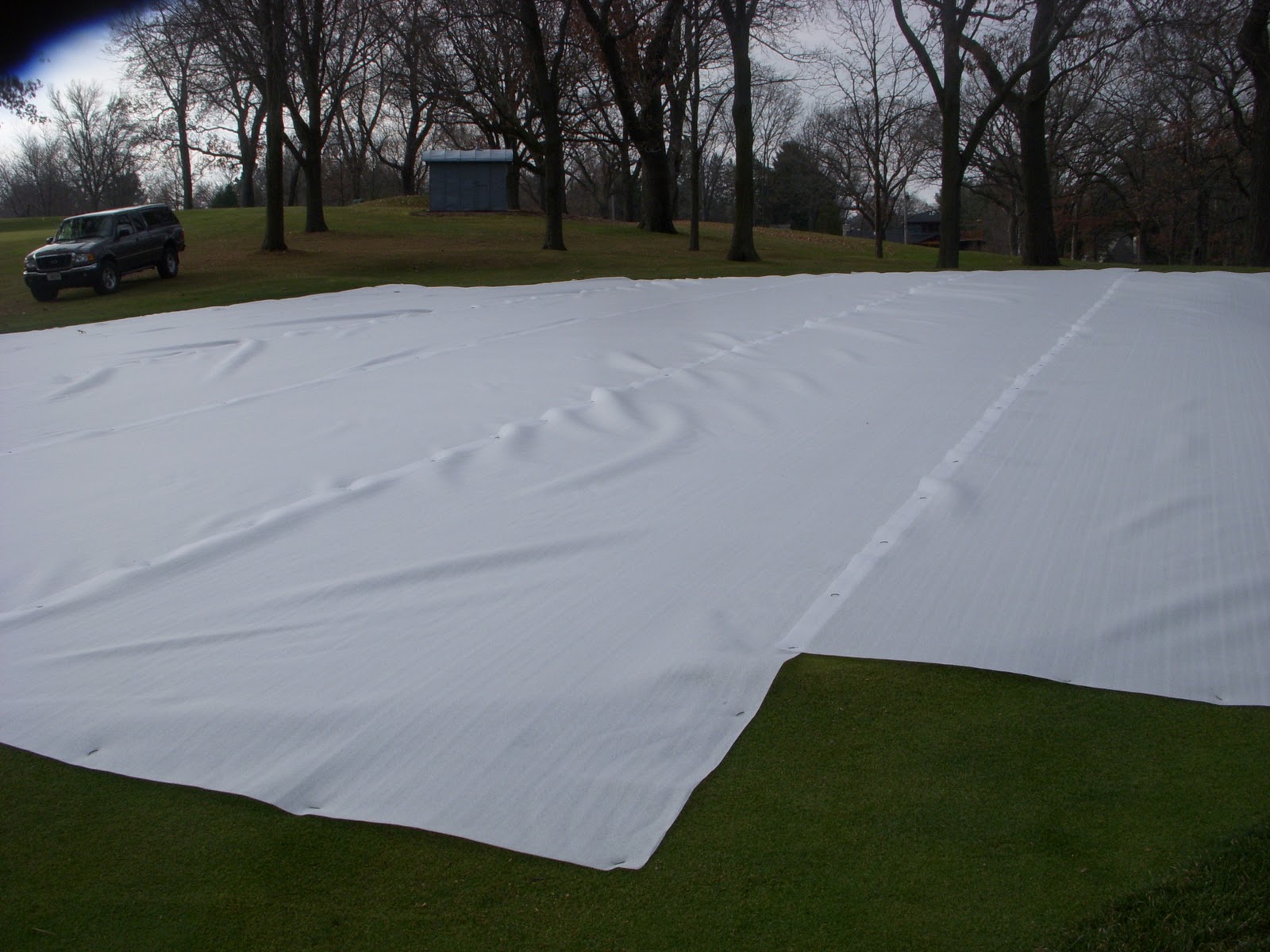
On Monday, we took advantage of the nice, calm conditions to prepare the greens for winter. As has been done for many, many years, a heavy layer of sand topdressing was applied to all of the greens, except 11 and 17 (more on that in a bit). Not only does the sand improve the overall soil profile, but it also helps to prevent winter injury by protecting the plants from desiccation. In response to the winter injury that the greens have received in recent years, 11 and 17 greens were covered with specially-designed, impermeable white plastic covers that are called GreenJacket covers. Through our own research and in consultation with USGA agronomist Bob Vavrek and Maple Bluff's superintendent Tom Harrison, these covers were chosen among the many options that exist. Essentially, they are supposed to eliminate injury by keeping ice off of the greens, and as you may remember, ice can kill turf by either rupturing the plants' growing points or by suffocation. To promote air exchange when the covers are layered in snow or ice, we will force in air using our backpack blowers on a weekly basis. It's our hope that we have an ice-free winter, but if we don't, these covers should keep these two particularly-susceptible (read: nearly 100% Poa annua) greens as healthy as possible.
Below are a couple of pictures of the covering process:
On Monday, we took advantage of the nice, calm conditions to prepare the greens for winter. As has been done for many, many years, a heavy layer of sand topdressing was applied to all of the greens, except 11 and 17 (more on that in a bit). Not only does the sand improve the overall soil profile, but it also helps to prevent winter injury by protecting the plants from desiccation. In response to the winter injury that the greens have received in recent years, 11 and 17 greens were covered with specially-designed, impermeable white plastic covers that are called GreenJacket covers. Through our own research and in consultation with USGA agronomist Bob Vavrek and Maple Bluff's superintendent Tom Harrison, these covers were chosen among the many options that exist. Essentially, they are supposed to eliminate injury by keeping ice off of the greens, and as you may remember, ice can kill turf by either rupturing the plants' growing points or by suffocation. To promote air exchange when the covers are layered in snow or ice, we will force in air using our backpack blowers on a weekly basis. It's our hope that we have an ice-free winter, but if we don't, these covers should keep these two particularly-susceptible (read: nearly 100% Poa annua) greens as healthy as possible.
Below are a couple of pictures of the covering process:
![]() |
| Next, the custom-sized impermeable covers were spread out and stretched as tightly as possible. |
Subscribe to:
Posts (Atom)