You know that it is dry when a local news channel's lead story is about drought-ridden lawns and that's exactly what happened last night. The last significant rainfall that the golf course received was 0.6" on May 30. Since then, we've received 0.2" of rain, and the recent stretch of hot, windy days certainly exacerbated the dry conditions. Thankfully, we entered this heatwave with very good rooting depth, and the playing surfaces have thus held up quite well. Over the past few days, two people have been handwatering dry spots all day. However, since our double-row fairway irrigation system is only able to water the edges of the rough, the wider rough areas are drying out substantially. Over the past two weeks, I have been using portable sprinklers attached to 100' hoses in an effort to keep these dry rough areas from entering dormancy, but it has been impossible to keep up with the evapotranspiration rates that we've been experiencing. Accordingly, unless we received a substantial (greater than a half inch) rainfall tonight, the rough will continue to be quite dry.
The positive side of the dryness is that this heat didn't bring any disease with it, and we're hoping that the drier rootzones will have prevented the turf roots from essentially boiling to death. While it's too soon to know for sure, our roots may have survived the heat (fingers crossed).
If you play this weekend, you may notice that the rough and green banks are longer than normal, and this is being done in preparation for the Taylormade Invitational that is being held here on Monday. Things will return to normal on Tuesday.
When we haven't been handwatering, we've completed a few small projects over the past two weeks, and the most noticeable was the addition of a perennial garden to the back right of 16 green. This area was unsightly from its frequent use as an unofficial cart path, and we hope that you like the garden and its associated walking path. We also completed come sod work behind 10 green and by the 6 tee bathrooms. Due to shade issues and cart traffic, the back left of 10 green had developed grass-less tracks, and with a little cart traffic control and the previously-removed tree that cast a significant amount of shade on this area, we're cautiously optimistic that we'll be able to keep some turf here.
Rain or not, we're looking forward to the break in weather that is coming tonight, but an inch of rain sure would be nice (and much needed).
Wednesday, June 20, 2012

Friday, June 8, 2012
Productive Week
If it were possible, we would have bottled this week's weather and replayed it throughout the summer. With minimal wind and temperatures in the 70s, it was a very productive week. After being here for a few weeks, our seasonal employees are settling in nicely and that has certainly helped us to take on duties besides mowing. Approaches and tees were fertilized with Milorganite, and the tees especially will appreciate this slow-release fertilizer. All of the fairways were also fertilized with a granular product. Typically, we fertilize the fairways with a granular product once per year and rely on smaller, more frequent doses of liquid fertilizer throughout the remainder of the year.
Also this week, traditionally dry spots on greens, tees, and fairways were treated with wetting agents. Soils in a golf course setting (especially those with a high percentage of sand) often become hydrophobic when water-repelling organic compounds coat the soil particles. Wetting agents act as a bridge between the soils and water and allow for more even moisture retention and penetration.
And, finally, much of the course was spot-sprayed for broadleaf weeds this week. Our primary weed targets at this time of the year were prostrate knotweed and white clover. Over the past few years, we've been aggressively trying to reduce the knotweed population in many rough areas. This particular weed does well in compacted soils, and with very few cart paths, the majority of the course's rough area are quite compacted. Earlier this spring, we also aerified and fertilized the worst of the areas to give the grass a fighting chance and to alleviate some compaction.
A few weeks ago, you probably noticed that two trees between 6 forward tee and the driving range were removed. Although one of the trees (a honey locust) was in poor health, they were targeted for removal because they impacted play from the left side of the practice tee, and the before and after pictures below illustrate just that:


Speaking of tree removal, a medium-sized linden tree that was located to the front left of 3 back tee was cut down. This tree made the back left of the tee unusable, and its elimination creates a very interesting angle for tee shots. Again, the before and after pictures are below.


Similarly, a linden tree that is to the front left of 15 tee was trimmed, and this will also allow for use of the back left portion of the tee.
We hope that you enjoyed the nice, cool week as much as we did and have an enjoyable, hot weekend.
Also this week, traditionally dry spots on greens, tees, and fairways were treated with wetting agents. Soils in a golf course setting (especially those with a high percentage of sand) often become hydrophobic when water-repelling organic compounds coat the soil particles. Wetting agents act as a bridge between the soils and water and allow for more even moisture retention and penetration.
And, finally, much of the course was spot-sprayed for broadleaf weeds this week. Our primary weed targets at this time of the year were prostrate knotweed and white clover. Over the past few years, we've been aggressively trying to reduce the knotweed population in many rough areas. This particular weed does well in compacted soils, and with very few cart paths, the majority of the course's rough area are quite compacted. Earlier this spring, we also aerified and fertilized the worst of the areas to give the grass a fighting chance and to alleviate some compaction.
A few weeks ago, you probably noticed that two trees between 6 forward tee and the driving range were removed. Although one of the trees (a honey locust) was in poor health, they were targeted for removal because they impacted play from the left side of the practice tee, and the before and after pictures below illustrate just that:


Speaking of tree removal, a medium-sized linden tree that was located to the front left of 3 back tee was cut down. This tree made the back left of the tee unusable, and its elimination creates a very interesting angle for tee shots. Again, the before and after pictures are below.


Similarly, a linden tree that is to the front left of 15 tee was trimmed, and this will also allow for use of the back left portion of the tee.
We hope that you enjoyed the nice, cool week as much as we did and have an enjoyable, hot weekend.
Saturday, May 26, 2012
Mother Nature: Good and Bad
It's been a very busy few weeks on the golf course, and this morning's rain is finally giving me a little bit of time to provide an update. Over the past two weeks, the majority of our summer crew arrived, and it was just in the nick of time. Thursday's windstorm created an absolute mess on the golf course, and all hands were needed to make the course playable again. In the eight years that I've worked at Blackhawk, it was the messiest that I've ever seen the course. Our crew did a tremendous job of getting everything back in shape for the Memorial Day weekend. There may still be a few more leaflets and sticks lying around than normal, but the course's transformation from Friday morning to afternoon was remarkable. Below are a few pictures that illustrate the mess that we had to deal with:

Two trees also snapped off by the lift that runs up the hill behind 9 green. One was a box elder, and the other was a tree that had already died. Luckily, no one was on the lift when either fell.
While the large limbs and downed trees did take a significant amount of time to deal with, the majority of our time was spent blowing smaller sticks and leaves off of the greens, tees, fairways, and green banks.
 |
| Two large maple limbs (above and below) broke off between holes 10 and 12. Both of these trees were already slated for removal, and Mother Nature just gave us a head start on taking them down. |

 |
| A large section of a crabapple on the range nearly hit our irrigation satellite. |
 |
| This linden tree on the left side of 7 actually broke off below ground. Thus, there's no stump to grind.
|
While the large limbs and downed trees did take a significant amount of time to deal with, the majority of our time was spent blowing smaller sticks and leaves off of the greens, tees, fairways, and green banks.
 |
| The picture above shows what the edges of most of the fairways looked like after they had been blown off.
But, on a positive note, we finally received some much-needed rain overnight and into this morning. It had been 19 days since our last rainfall, and with warm air temperatures, low dew points, and windy days, our irrigation system was working overtime. Although the course was playing very fast and firm, unirrigated rough areas were beginning to exhibit drought stress.
Have a great Memorial Day weekend!
|
Wednesday, May 2, 2012
Aerification Complete
Despite the semi-uncooperative weather from Sunday evening through Monday morning, the greens aerification has been completed, and all-in-all, it went very well.
On Sunday afternoon, our fantastic group of overqualified part-time workers allowed us to aerify and clean nine greens. Then, it rained 0.7" and was cool and drizzly on Monday. Because of the muddy, slimy mess that additional aerification would have resulted in on Monday, our efforts were instead focused on backfilling the holes on the front nine. Tuesday brought ideal aerification weather, and we were able to aerify, clean, and backfill the back 9. Between classes, six UW-Madison turf students lent a hand on Tuesday and did a great job as usual.
Below is a photo journal of the process that we use to aerify your greens at Blackhawk:
 First, select greens are deep drilled. This machine has 5/8" diameter by 10" long drill bits that are spaced 5" apart. The holes that are created by this machine really help the greens drain well and break the layer between the native soil that the greens were originally built with and the layer of sand topdressing that has been built up over the years.
 The deep drill doesn't bring up a lot of soil, but the deep holes stay open for a long time. Because deep drilling is a slow process and because we only own one machine, we're not able to use this method on all of the greens each year. This year, eight greens were deep drilled.
 Core aerifying was completed on all of the greens, and if the green was scheduled to be deep drilled, the drilling was done prior to the coring. These machines bring up a 1/2" diameter by 3-4" long core on 2" spacing.
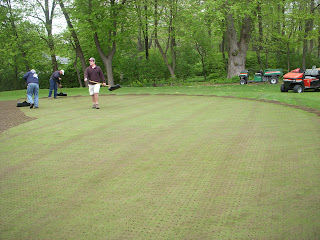 The significant mess is then shoveled to the collars for collection. This is the most back-breaking portion of aerifying, but with enough workers, it's not too bad.
 A heavy layer of sand topdressing is then applied to the greens. Given the variable moisture of our sand, it's always tricky to put down the correct amount of sand, but Chad got as close as is possible. This year, approximately 22 tons of sand were used.
 Once the sand is good and dry, the greens are drug four times to get the majority of the sand into the holes.
 Since the machine drag isn't able to get all of sand into the holes, a large crew that's armed with backpack blowers, shovels, and brooms follows behind and systematically works the sand across the green until the holes are filled and a minimal amount of sand is on the turf canopy. Although time consuming, this allows for the best, smoothest finished product that we can provide.
Lastly, the green is rolled to smooth out any ridges that the aerifiers may have made, the hole is cut, and it's ready to go.
Although it's going to undoubtedly create a wet golf course, the 0.3" of rain that we received this morning helped to further clean the greens by pounding the sand into the turf canopy. With the temperatures that are forecasted for the next few days, we are optimistic for a speedy recovery and for hole-free greens in the near future.
Speaking of weather, Mr. Rath emailed Chad and me the following, "The average temperature for March 2012 was 50.1 °F which was 16.1 degrees above normal. The average in April was 47.9 °F, 2.2 degrees cooler than March! April was also near normal for Madison, finishing 1.3 °F above the average temperature of 46.6 °F." This was the first time in Madison's weather history that March was warmer than April.
On Sunday afternoon, our fantastic group of overqualified part-time workers allowed us to aerify and clean nine greens. Then, it rained 0.7" and was cool and drizzly on Monday. Because of the muddy, slimy mess that additional aerification would have resulted in on Monday, our efforts were instead focused on backfilling the holes on the front nine. Tuesday brought ideal aerification weather, and we were able to aerify, clean, and backfill the back 9. Between classes, six UW-Madison turf students lent a hand on Tuesday and did a great job as usual.
Below is a photo journal of the process that we use to aerify your greens at Blackhawk:


Lastly, the green is rolled to smooth out any ridges that the aerifiers may have made, the hole is cut, and it's ready to go.
Although it's going to undoubtedly create a wet golf course, the 0.3" of rain that we received this morning helped to further clean the greens by pounding the sand into the turf canopy. With the temperatures that are forecasted for the next few days, we are optimistic for a speedy recovery and for hole-free greens in the near future.
Speaking of weather, Mr. Rath emailed Chad and me the following, "The average temperature for March 2012 was 50.1 °F which was 16.1 degrees above normal. The average in April was 47.9 °F, 2.2 degrees cooler than March! April was also near normal for Madison, finishing 1.3 °F above the average temperature of 46.6 °F." This was the first time in Madison's weather history that March was warmer than April.
Wednesday, April 25, 2012
Greens Aerification
It's just about that time of the year again... If you've noticed, the tee sheet on Sunday, April 29 closes at 2 pm for that twelve-letter curse word: aerification. Right now, the weather looks cooperative for Sunday and Monday, and the course will be closed as scheduled to allow for greens aerification.
Last week, we applied fertilizer to the greens to provide them with ample nutrition to cover the many millions of sand-filled holes that we are going to be creating. Now, we just need Mother Nature to warm things up to get the grass growing. Hopefully, she will cooperate and everything will heal quickly.
Yesterday, we tested out the two core aerifiers and deep driller on the chipping green, and all of the equipment worked like a charm. Thus, the greens are now 1/20 of the way done.
As we've done for a long time, we're having the UW-Madison Turf Club help us clean the greens and fill the holes on Monday. These guys provide labor that is otherwise unavailable at this time of the year, and they really do a great job. This project is also the major fundraiser for the Turf Club, so it's most definitely mutually-beneficial.
With the great condition that the greens are in, you might be wondering why we find the need to make them sandy and bumpy. However, the benefits are many (thatch removal, increased oxygen in the root zone, deeper roots, better water infiltration and percolation), and a little bit of inconvenience now is worth it in the long run. Blackhawk's old, Poa annua greens have been mostly unscathed over the past two extreme summers, and diligent core aerification is no small factor in our ability to keep them healthy. As I've said before, it's a necessary evil.
I'm going to attempt to take pictures to document the entire process and will post the results next week.
Last week, we applied fertilizer to the greens to provide them with ample nutrition to cover the many millions of sand-filled holes that we are going to be creating. Now, we just need Mother Nature to warm things up to get the grass growing. Hopefully, she will cooperate and everything will heal quickly.
Yesterday, we tested out the two core aerifiers and deep driller on the chipping green, and all of the equipment worked like a charm. Thus, the greens are now 1/20 of the way done.
As we've done for a long time, we're having the UW-Madison Turf Club help us clean the greens and fill the holes on Monday. These guys provide labor that is otherwise unavailable at this time of the year, and they really do a great job. This project is also the major fundraiser for the Turf Club, so it's most definitely mutually-beneficial.
With the great condition that the greens are in, you might be wondering why we find the need to make them sandy and bumpy. However, the benefits are many (thatch removal, increased oxygen in the root zone, deeper roots, better water infiltration and percolation), and a little bit of inconvenience now is worth it in the long run. Blackhawk's old, Poa annua greens have been mostly unscathed over the past two extreme summers, and diligent core aerification is no small factor in our ability to keep them healthy. As I've said before, it's a necessary evil.
I'm going to attempt to take pictures to document the entire process and will post the results next week.
Subscribe to:
Posts (Atom)